
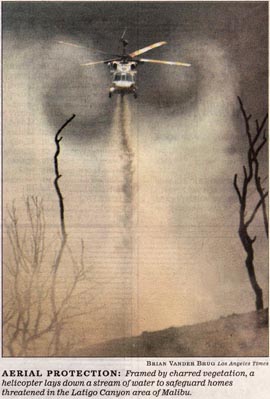
A very simple demonstration is to attach a one kilogram mass to a spring scale and lower the mass into an aquarium of water. The weight under water is considerably less than the weight in air.
We have a much more elaborate apparatus with two large produce-type grocery scales, one over the other. The lower one holds a pan of water, and the upper one weighs a mass in air or in the water. You can measure the dimensions of the mass, compute the volume it displaces, weigh it in air and in water, and note how the weight of the pan of water changes when the mass is lowered into it.
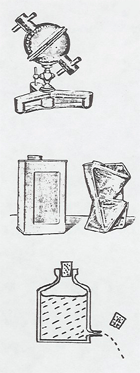
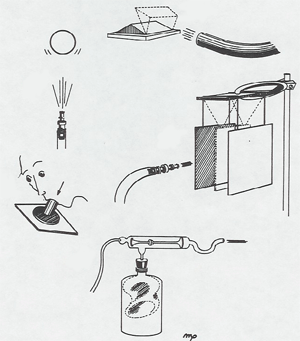
Several short demonstrations nicely illustrate Bernoulli's principle.
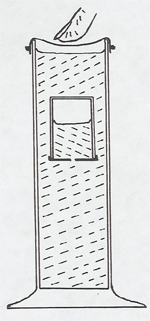
In a container of water sealed with a rubber diaphragm top is a smaller floating container partially filled with water and with a small hole in the bottom. When the rubber diaphragm is depressed, the air in the smaller container is compressed, increasing the volume of water in the smaller container and reducing its buoyancy. Thus, the smaller container sinks. Its level can be controlled by the finger pressure on the diaphragm.
Water is added to a connecting set of tubes with progressively smaller bores. Capillary action raises the water progressively higher in the smaller bores.
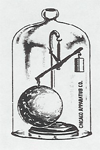
A bell jar with several demonstrations is evacuated in class:
A container has four immiscible fluids floating, one above the other - mercury, carbon tetracloride, water, and naptha. You can lower in small cubes - balsa, hardwood, plastic, and aluminum - to float at each interface.
Demo 1
A manometer with a rubber diaphragm-covered probe and an aquarium filled with water and a marked level of depth are provided. The pressure probe is inserted under the water to the marked level of depth and faced up, down, and sideways. The pressure reading is the same for all directions.
Demo 2
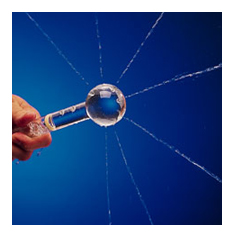
Pressure Syringe (aka Pascal's Demonstrater) Fill the syringe with water, push the plunger, and watch the water shoot out of every hole equally.
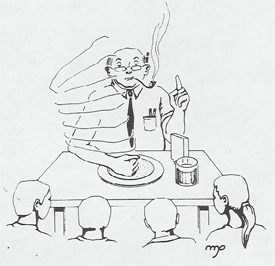
Corn starch and water are mixed in a plate to produce a goopy mixture that can be scooped up and dribbled with a spoon. Inviting the students to look closer, the professor suddenly slams his or her fist down on the mixture, causing the students to jerk back - but the mixture doesn't splatter; it momentarily becomes rock hard when acted on by a large force. Another type of behavior is demonstrated by dragging a spoon rapidly through the mixture to cause a ripping action.
Also available is "silly putty" which is hard and elastic under large forces but flows under small forces. Mold it into a ball and bounce it, and then leave on the lecture table; in ten or twenty minutes it will flow out under gravity.
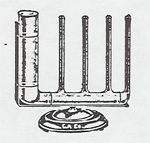
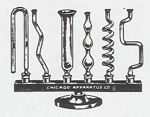
A set of tubes of different shapes are connected to a common source of water. When filled, the water reaches the same level in all the tubes.
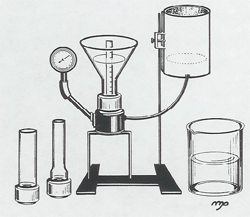
This is a demonstration that pressure depends on depth only and not on the shape of the vessel. The reservoir on the right is adjusted for the same level of fluid in each "vase", and the gauge reads the corresponding pressure.
With a right-angle plywood trough covered with sandpaper, you can put a tremendous curve on a ping-pong ball, even curving upwards from a horizontal throw.
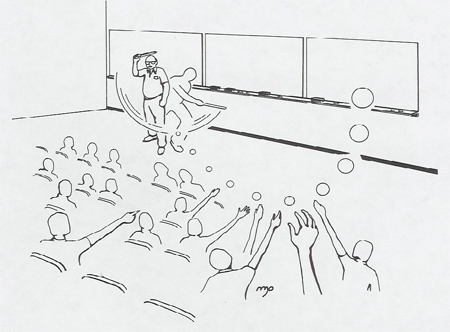
Suggested by Prof. D. Pursey from Iowa State, who is shown above in action.
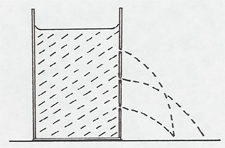
A can has openings one quarter of the way down, one half of the way down, and three quarters of the way down. When filled, water flows out the openings. From which hole will the stream impact furthest from the bottom of the can?
Bottles of water and glycerin have similar beads in them which sink at different rates according to the viscosity of the fluid.