
This is the famous torsional wave device. Among the concepts that can be demonstrated are:
A descriptive booklet is available.
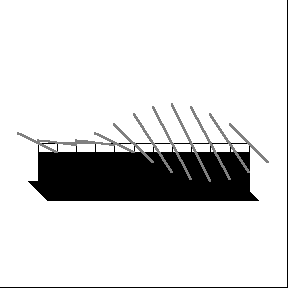
See Doppler Shift (Acoustics) [1].
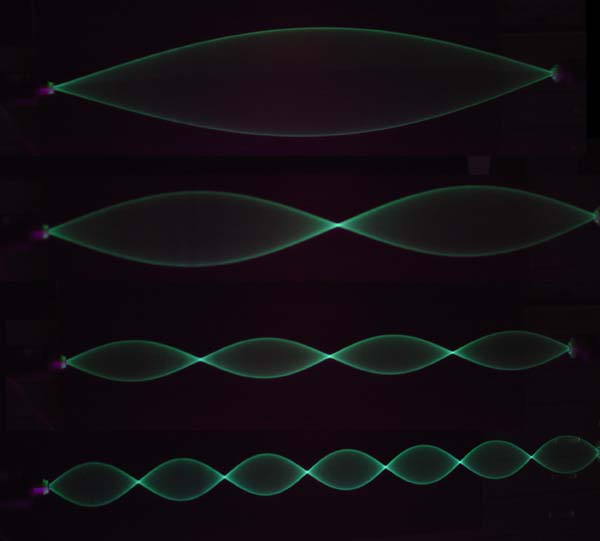
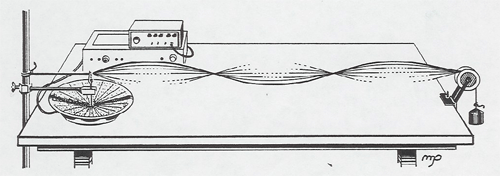
This demo illustrates the normal modes in standing waves. A black light shines on a motor- driven fluorescent string. As the input frequency changes and corresponds to one of the normal modes or harmonics, the nodes and antinodes appear. A strobe may be used to "freeze" a particular harmonic.
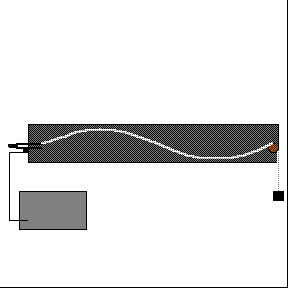
The Pasco Fourier synthesizer produces two 440 Hz fundamentals and eight exact harmonics. You can vary the amplitude and phase of any of these signals and add them up to generate a complex wave form. The output goes to an oscilloscope and also to a speaker so the class can hear the wave form. The two fundamentals can be added alone to show the sum of two sine waves, or sent to two speakers to demonstrate acoustical interference.
The Fourier analyzer shows the power spectrum of a complex wave form on an oscilloscope.
Applet by Fu-Kwun Hwang --- Virtual Physics Library [2]
How to play:
The default value for base frequency is f=100Hz, you can change it from the TextField (20 < f < 2000). The ear is 1000 times more sensitive at 1kHz than at 100Hz.
| frequency range | ||
| speech | song | |
| adult male | 80-240 | up to 700 |
| adult female | 140-500 | up to 1100 |
Can be illustrated with Moiré patterns on the overhead projector, or by adding sine waves of two different frequencies on the oscilloscope (M.P. Hagelberg, Am.J.Phys. 46(5),579 (1978)), or by showing a good film strip on the subject (#600).
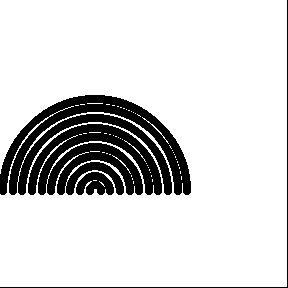
Our large Kundt's Tube designed by Prof. Rudnick dramatically demonstrates standing acoustical waves. The speed of sound can also be measured. See Kundt's Tube (Acoustics) [3].
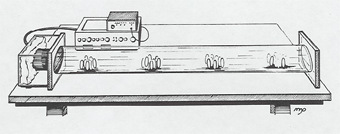
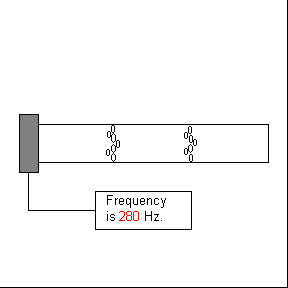
|
Further demonstrations that can be done with the Kundt's tube are described here [3] in the Acoustics section of the demo manual. |
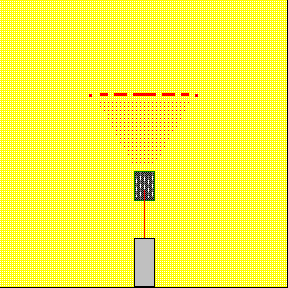
A laser through various slits will project interference and diffraction patterns on the overhead screen. See Single, Double, and Multiple Slits [4].
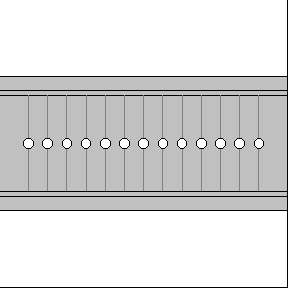
A Russian wave machine separately models the motion of a string of beads undergoing transverse and longitudinal wave motion. The mechanism of its operation is almost more interesting than the effect it demonstrates.
Longitudinal and transverse waves can also be separately demonstrated by the Space Phone [5] and the Rubber Hose [6]. A slinky can be used to demonstrate both also.
 |
|
The 8D microwave lab setup can be used to demonstrate standing waves, interference, diffraction, polarization, and tunneling. A large lecture hall meter displays the output readings to the class.
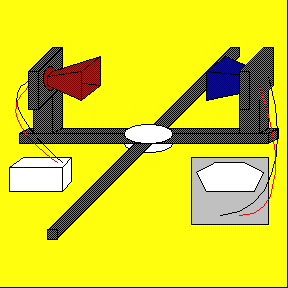
Ultrasonic sound wavelength and interference can be demonstrated. See Acoustical Interference [7].
Stretches across the front of the lecture hall to illustrate standing wave modes. Strobes can be used to stop the motion.
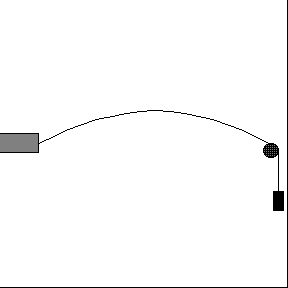
Our large ripple tank projects on the overhead screen to demonstrate reflection, interference, diffraction, etc.

Clamp a wave spring or rubber hose to the table and you can send a pulse along and see it reflected. The brass spring works best. Free end reflection can be accomplished by attaching a 1/2 meter long string to the end of the spring. If the end of the hose or wave spring is laid on the floor, you can send a pulse down and have it absorbed with no reflection.
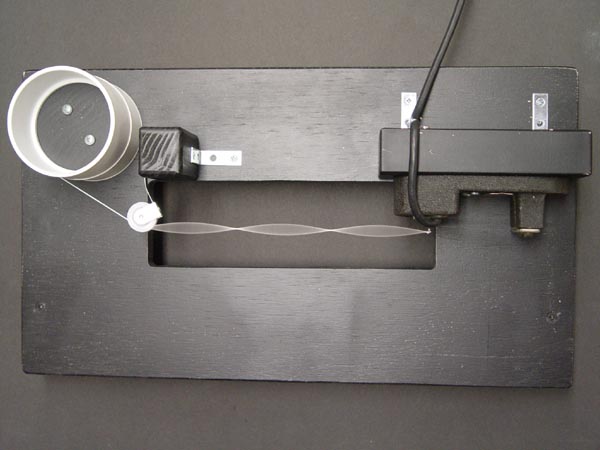
is a longer, thicker string driven by a speaker. Hence, the driving frequency as well as the string tension can be varied. The equation v = (f/m)1/2 can be checked with either demonstration. This demo stretches across the front of the lecture hall to illustrate standing wave modes.
Vibrations of soap films on wire frames show various modes of oscillation.
This device can be used to demonstrate longitudinal and transverse waves. A pinch of the spring demonstrates a longitudinal wave and a pulse sent be flicking the wrist sends a transverse wave.
Metronomes of the same frequency and resting on the same base are started randomly. They synchronize after a short period of time. In this case the base is free to move. In 1657, Christian Huygens was the first to observe this phenomenon in the form of clock synchronization. The phenomenon of spontaneous synchronization is found in circadian rhythms, heart& intestinal muscles, insulin secreting cells in the pancreas, menstrual cycles, ambling elephants, marching soldiers, and fireflies, among others.
Links:
[1] https://demoweb.physics.ucla.edu/node/61
[2] http://www.physics.ucla.edu/demoweb/ntnujava/indexPopup.html
[3] https://demoweb.physics.ucla.edu/node/63
[4] https://demoweb.physics.ucla.edu/node/90
[5] https://demoweb.physics.ucla.edu/node/280
[6] https://demoweb.physics.ucla.edu/node/279
[7] https://demoweb.physics.ucla.edu/node/52
[8] https://demoweb.physics.ucla.edu/sites/default/files/demomanual/harmonic_motion_and_waves/waves/spring_wave_long.mov