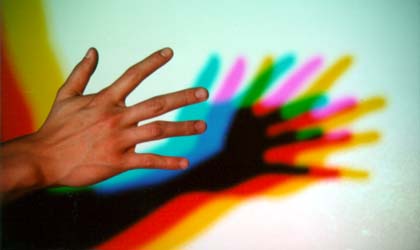
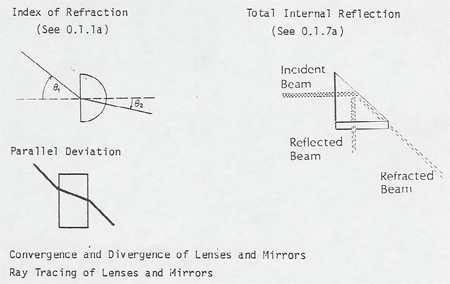
The kit has been improved with magnetic clamping to the blackboard and a multiple ray projector. Most of the principles of geometrical optics can be nicely demonstrated with this kit
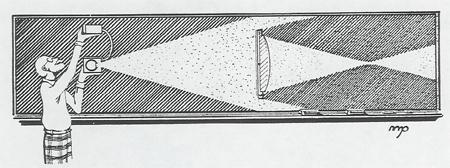
We have a light which magnetically clamps to the blackboard and projects five parallel rays. This dramatically shows convergence and divergence of rays in lenses and mirrors.
The Lenses and Mirrors applet below can be used as an online demonstration.
Physlet by Wolfgang Christian webPhysics, Davidson College [1]
Instructions on how to use the animation:
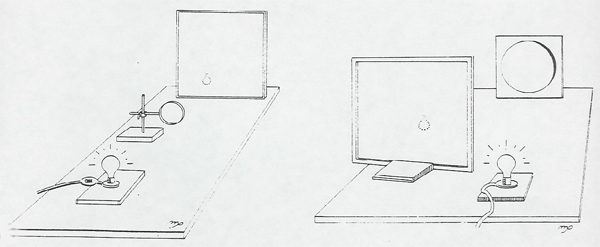
The setups below demonstrate the formation of the real, inverted image by a lens or mirror.
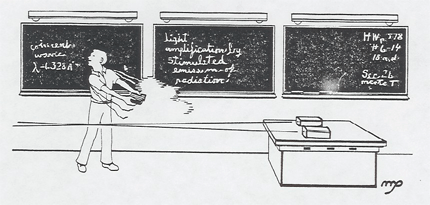
The laser is used in many demonstrations, but the students are delighted with the device itself.
First make a spot on the side wall and then catch it on your hand to show that the beam will not burn a hole through your hand. A short discussion of the dangers of looking down the beam is appropriate at this point.
Then place the laser on the table so the beam hits the side wall, walk along to the middle of the beam, and clap erasers over it so the pencil-like beam is outlined in falling chalk dust. We also have fog-in-a-can available for outlining the laser beam. (This is very effective.)
A similar stunning demonstration for a small group to gather around is to ask for a volunteer with a diamond ring. Beam the laser into the diamond, and clap chalk dust over it. The many tiny beams emerging from the diamond are very beautiful. The beam pattern can be used to "fingerprint" the diamond uniquely.
Another short demonstration is to place a human hair in the beam. From the resulting diffraction pattern and the wavelength of the laser, you can calculate the diameter of the hair.
A Metrologic publication "101 Ways to Use a Laser" is available.
A strongly converging lens shows obvious chromatic aberration. Another strongly converging lens is arranged so that the outer half of its diameter can be blocked (lens "stopped down"), or the inner half can be blocked (leaving an annular ring lens). The two arrangements have different focal lengths showing spherical aberration.
Other types of aberrations can be arranged with various lenses and mirrors.
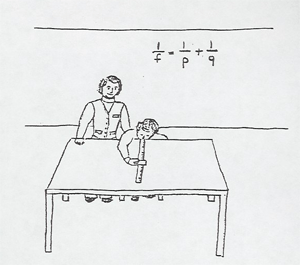
The near (pn) and far (pf) focusing distances of a student volunteer and his/her glasses prescription computed. The impressive thing about this demonstration is that you pay the optometrist $25 for the same service!
To measure the near and far focusing distances without danger of poking a ruler in the volunteer's eye, lay the ruler or meter stick on a lecture table with it's end at the edge of the table.. A volunteer should be chosen who is nearsighted without serious astigmatism (glasses diverging and rotationally symmetric). The volunteer is seated at the table and places his eye at the end of the ruler. Using a 3 X 5 card with fine print, the volunteer quickly determines the nearest and furthest distance he can focus clearly on it.
Without justifying the steps, the calculation goes as follows:
q = optical path length of eyeball, this is fixed for a particular individual and is unknown.
ff = focal length of eye lens and cornea with muscles relaxed.
fn = focal length of eye lens and cornea with muscles max contracted.
fg = focal length of glasses (to be determined).
Then,
1/ff = 1/q + 1/pf
The glasses should correct the far point to infinity, so
1/ff + 1/fg= 1/q + 1/infinity
Subtracting,
pg = 1/fg = -1/pf
Will the "patient" be able to read with these glasses on? Compute his near focusing distance pn' with glasses on.
1/fg + 1/fn = 1/q + 1/pn
Thus,
1/pn' = 1/fg + 1/pn
The quantity pn' should be less than 25 cm for easy reading. Otherwise the "patient" will need reading glasses or bifocals.
The power of accommodation can also be computed.
POA = pn - pf = 1/fn - 1/ff = 1/pn - 1/pf
In the farsighted case the person's far point will be beyond infinity, so to speak; that is, his eye will not focus at any finite distance, when relaxed. To handle this case, introduce a converging lens of known power pc = 1/fc at the person's eye. (The power should be chosen to bring his far point in to an easily measured distance, half a meter or less.) Then measure the near and far point through the converging lens. The equations are now
1/ff + 1/fc = 1/q + 1/pf
and
1/fn + 1/fc = 1/q + 1/pn
and fg can be computed as before from the known value of fc.
This demonstration was inspired by Chapter 26 of College Physics by Franklin Miller, Jr. (Harcourt Brace Jovanovich, New York, 1977).
(Art Huffman, A.J.P. 48, 309 (1980))
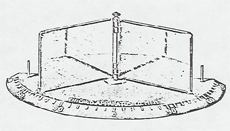
A peanut bulb is placed between two large folding mirrors attached to eachother with a hinge. By changing the angle between the mirrors, the number of images change.
A set of color filters can be projected in a triangular overlapping circle pattern. Filters available are red, blue, green, and minus red, minus blue, and minus green.
The Rav'n light is a small pulsing light that looks white. When swung around on a string you can see that it is made up of only red, green, and blue pulses.
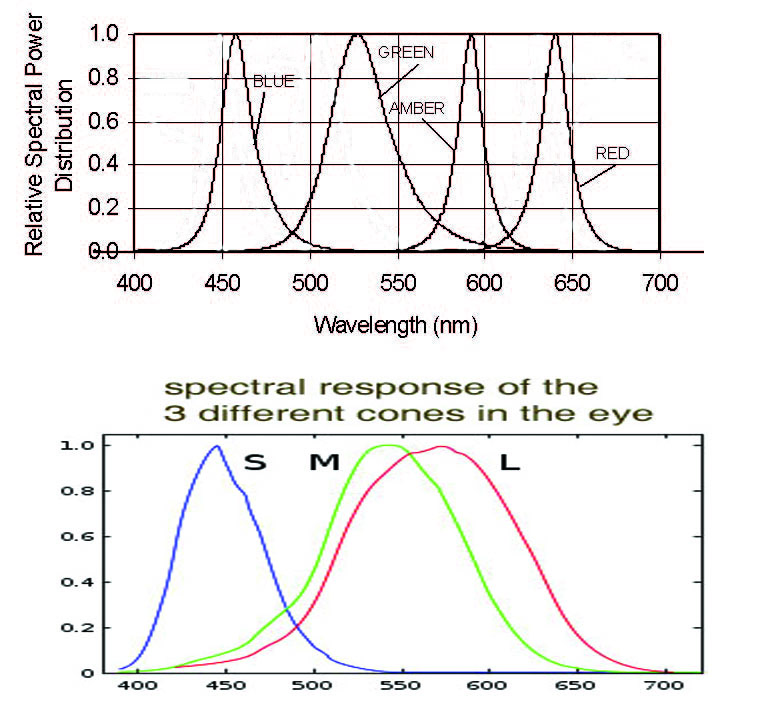
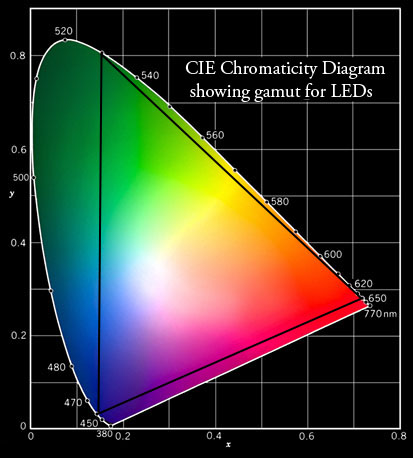
There is a new set of red, green and blue leds which can be projected into overlapping circles. The intensity of each light can be adjusted to some extent to make any color in the overlapping region. An amber led is also available and can be compared to a mixture of red and green. This can be used to discuss how the eyes see color. Why for instance, do red and green light, with no wavelengths in the yellow spectral region, give the sensation of yellow? The answers can be found in the sensitivity of the three types of cones in the eye. Sample led spectra, cone sensitivity, and the CIE diagram are below. The CIE diagram can be used to describe the gamut of any display device. For more info go here. [2]
Also available are hand-held color mixers. One device has a tricolor red, blue and green LED with three switches. By pressing two of the three switches, the secondary or negative colors are made and by pressing all three at the same time we get white light.
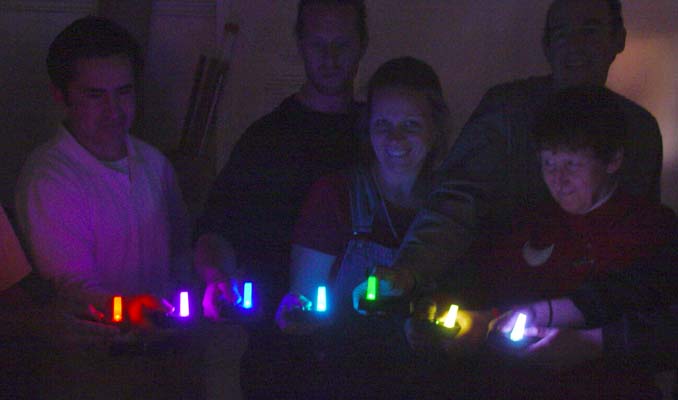
Participants at a workshop show the seven possible colors after making this little color mixer with a tricolor led. This is similar to controlling a single pixel of a 3 bit RGB display. Black is the eigth color.
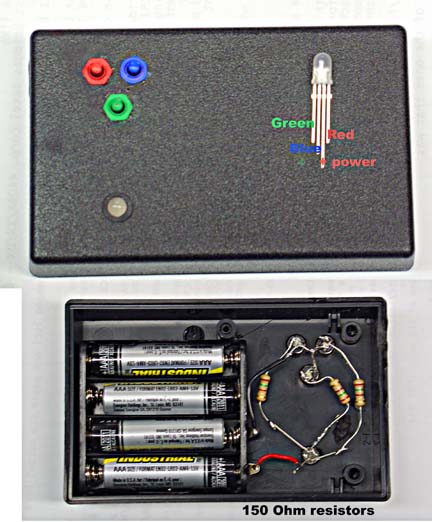
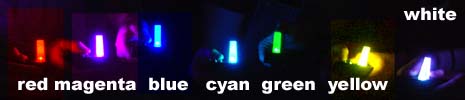
The tri color led can be found here [3].
Color Algebra
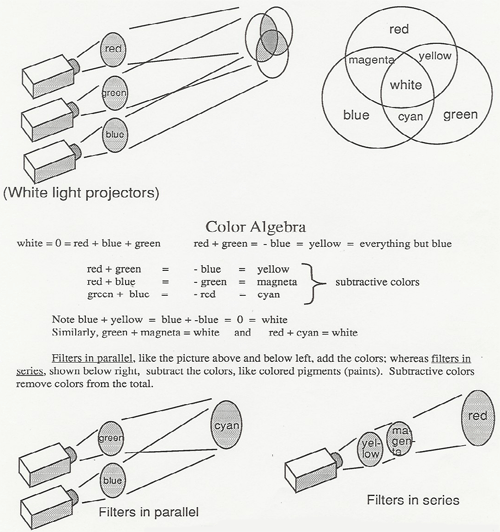
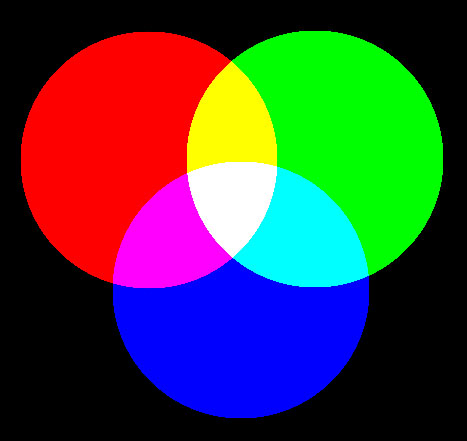
Light from red, green and blue LEDs is projected into overlapping circles. The intensity of each LED light can be adjusted to make white or other colors in the overlapping region.
Spectral colors are characterized by the wavelength of the electromagnetic radiation. The shortest wavelength that can be seen by the eye is 380 nm violet. The longest wavelength which can be seen is 770 nm red. The wavelengths of the light produced by the red, green, and blue LEDs is shown in the top graph, along with that of an amber LED.
One interesting thing to note is that the spectrum of the amber LED does not overlap very much with the spectrum of the red and green LED. The light from the red and green LEDs does not contain any amber wavelengths around 590 nm, yet we see the color amber when we mix red and green light. Why is this?
The answer can be found in the sensitivity of the three types of cones in most peoples eyes (see the second graph). These are sensitive to short, medium, and long wavelengths which roughly correspond to blue, green and red light. Amber light at 590 nm, excites both the green and red cones. We can fool the brain into seeing amber, by supplying the right amount of red and green stimulation. That's why color mixing works. However, everyone's eyes are different. Some people only have two types of cones and have some color blindness. Some reportedly have four types. The ratio of red to green cones varies widely from person to person. The ratio of red and green light to match the spectral 590 nm amber also varies from person to person. We don't all see the same colors.
RGB display devices like TV's and monitors project red, green, and blue light to produce the sensation of all the colors. The CIE diagram shows all the colors that can be perceived by the eye/brain. The spectral colors lie on the white curve identified by wavelength and all the various mixtures appear inside. The color gamut of a display device is that part of the full range of colors that the device can reproduce. The color gamut of the red, green and blue LEDs is the area inside the triangle with vertices at the wavelengths of the LEDs. Colors outside the triangle cannot be matched by mixing the light of those LEDs. How close can we get to spectral amber?
Printer inks, paints, and filters use subtractive rather than additive colors. Instead of red, green, blue, printer primaries are usually cyan, magenta, yellow, and black. Printers also have a color gamut and can't reproduce colors outside their gamut. This can lead to problems when the display gamut doesn't match the printer gamut. Colors that can be seen on the screen can't be printed.
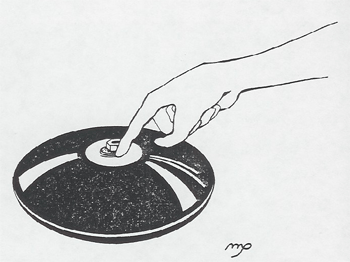
Real: The "UFO shaped Optical Illusion" produces a stunningly real looking 3D image of a small object placed inside it. A laser can be shined right on the image, demonstrating optical reciprocity. The device consists of two parabolic mirrors, each at the focus of the other. The object is placed on the lower mirror at the focus of the upper mirror. Beams from the object diverge to the upper mirror and are reflected parallel down to the lower mirror, whence they are converged up through a hole in the upper mirror to form the image.
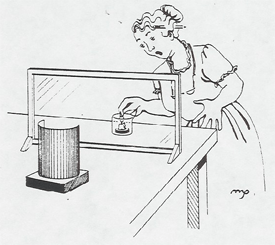
Virtual: In this impressive demonstration the virtual image of the flame of a concealed candle in a sheet of plate glass appears over an unlit candle wick. You can put your finger in the "flame" and grimace, or pour water over it and not put it out
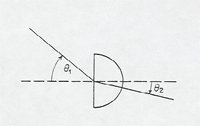
Index of Refraction: With the Blackboard or Whiteboard Optics semicircle piece you can measure the index of refraction of the lucite material directly with Snell's Law This will be a useful value later if you plan to use the rectangular block for parallel deviation or the prism for total internal reflection. Then you can predict and check results from your measured value of n. See Blackboard Optics [4] and Measuring a Glasses Prescription [5].
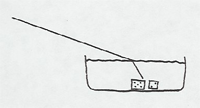
A beam of light is passed through a cell containing precipitated sulfur and then focused on a screen. As the sulfur precipitates, the transmitted beam becomes redder as more and more of the blue light is scattered out of the beam to the sides. The side scattered light can be shown to be polarized.
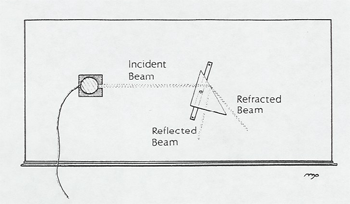
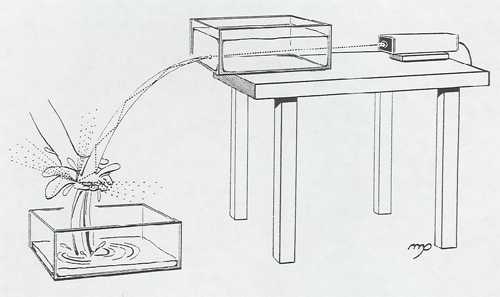
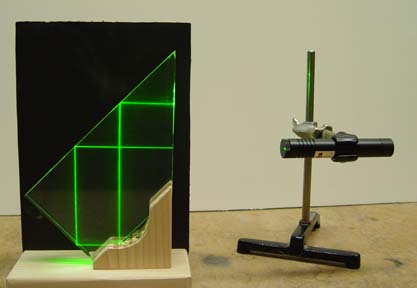
Small ultrasonic piezoelectric transducers serve as transmitters or receivers for centimeter sound waves. A simple setup with two transmitters hooked to the same signal generator produces a very nice interference pattern read out on an oscilloscope. (See Acoustical Interference [7])
A hollow prism filled with carbon disulphide will disperse white light into its component colors. Other glass and lucite prisms are available, but their dispersion is not as great as CS2.
A laser transmission hologram can be set up for individual viewing by the students. One is of a magnifying glass in front of a watch. You can look behind the magnifying glass and see the watch, or look through it and move your eye in and out to see the focus change.
A classic white light "multiplex" image of a woman blowing a kiss is available as well as other reflection type holograms of a microscope, skulls, etc.
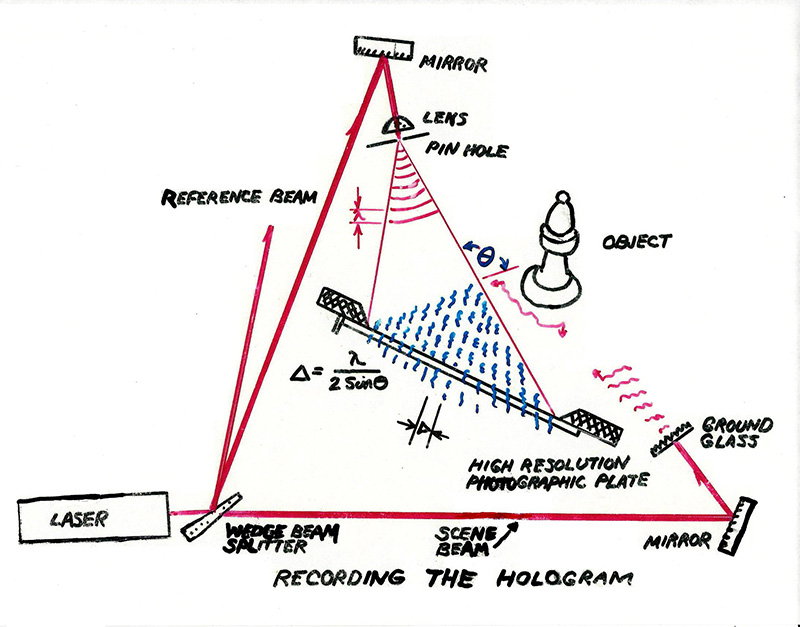
A small interferometer can be demonstrated in class. This is useful when discussing relativity besides the optics application. The fringe pattern can be projected onto the overhead screen, and you can measure the wavelength of the laser light by advancing one of the mirrors with a micrometer screw and counting fringes.
In a very similar setup reflected light from a Newton's rings apparatus is focused on the rear projection screen and the circular colored fringes observed.
Our large ripple tank projects onto the overhead screen to demonstrate reflection, diffraction, interference, etc.
Also available is an PHET applet [8] that nicely demonstrates the interference and diffraction of waves.
A laser beam is arranged to pass through the slits and be reflected onto the overhead screen. Standard demonstrations are single slit diffraction, double slit interference, and diffraction from a circular opening. Two lasers are arranged so that single and multiple slits can be shown simultaneously, one pattern above the other.
We have precision slits etched in metal foil. The slit widths and spacings are marked. The most useful single and double slits have a width of .04 mm. The double slit spacings are .125, .250, and .5 mm. There is also 3, 4, and 5 slits with the same width (0.04 mm) and spacings of .125 mm.
Hair, CD's and DVD's can be used as diffraction gratings. Simple measurements of the first maximum gives the track spacing. Comparing the pattern from CD's and DVD's gives the ratio of the track spacing for the higher density DVD.
The diffration pattern can be observed with both a red and a green laser simultaneously to show the effect of wavelength. The red laser wavelength is 0.6328 micron and the green laser is 0.532 micron.
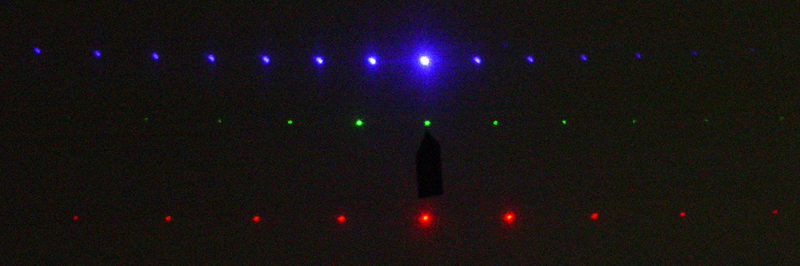
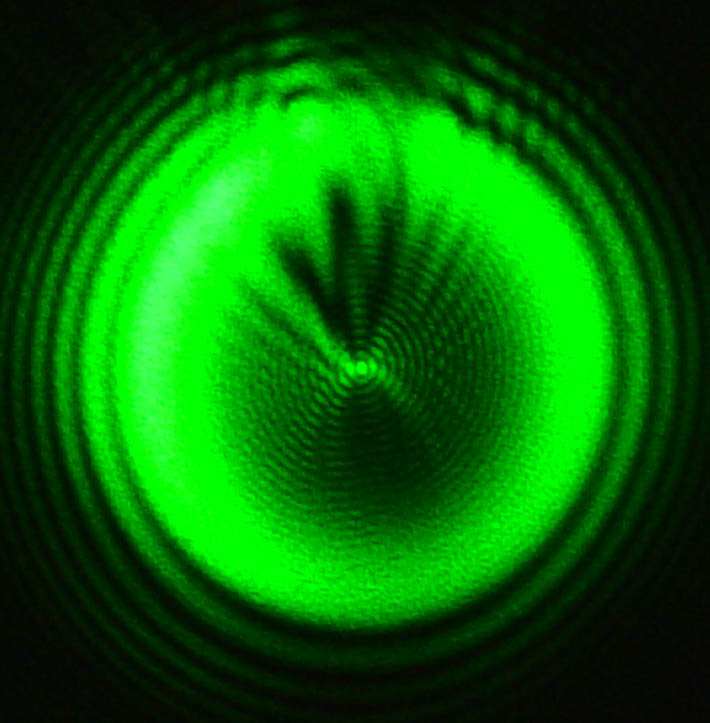
A small ball bearing in a laser beam can show the Arago bright spot (or Poisson spot) in the center of the shadow as seen below. This image also shows the fine structure in the shadow. This demo is best when the students can come right up to the shadow image and look at it directly.
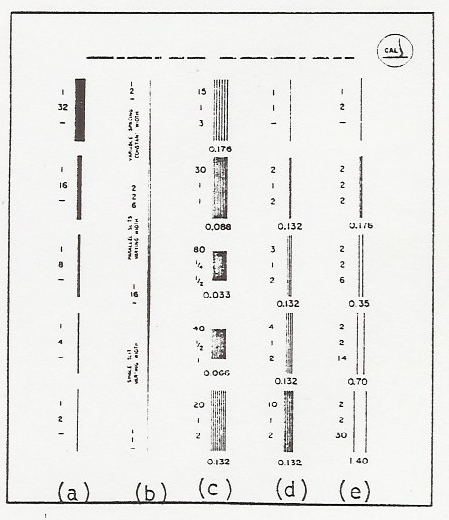
The Cornell plate, diagrammed below can also be used for these demonstrations. It is clipped to a special stand so that successive slits in each column can be brought into the laser beam by adjusting a rack and pinion knob.
Column (a) Successively narrower single slits
Column (e) Successively wider double slits
Column (b) Single slit starts narrow, becomes wider,
becomes double slit, becomes narrower.Column (d) Go from one slit to two slits to three to four to ten to show sharpening
of the fringe maxima.
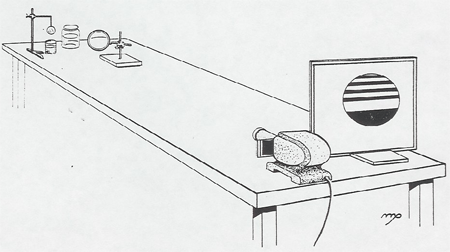
The Cornell plate was originally designed to be used (and can still be used) with the individual eye to view a straight filament bulb.
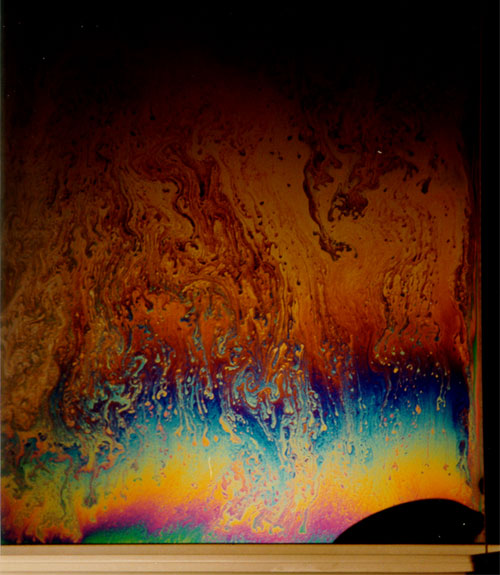
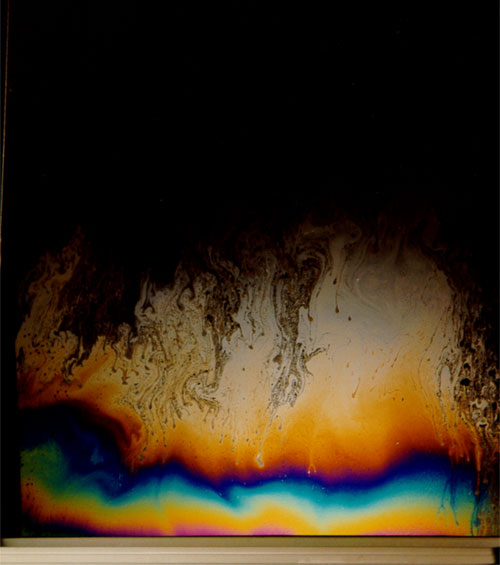
In this pretty demonstration light reflected from a soap film is focused on a rear projection screen. Gravity makes the soap film thicker at the bottom, so the image is a series of colored fringes produced by interference between the light reflected from the front and back surfaces of the film. As the water evaporates, the soap film becomes thinner, and a black area appears at the top of the film (bottom of the screen, if using a lens). When it becomes thinner than 1/4 (lambda/n), it represents destructive interference owing to the 180° phase change at the outside surface. The images below show this effect. (The phase changes at free and fixed ends can be demonstrated with the Bell Wave Machine [9].)

A set of optical instruments is available. Most of them are in a box which you can keep at the front of the class for the students to come down and look at. You have to sort of watch over them to make sure none get dropped or lost. Or you could pass one at a time around and carefully collect it afterwards.
There are opera glasses, which consist of a pair of Galilean telescopes made from a diverging eye lens and a converging objective. This arrangement produces an erect image with only two simple lenses, but at the expense of low power and small field of view. Prism binoculars have converging eye lenses, probably two elements each, with prisms to fold the optical path and erect the image. A pair of Porro prisms is available to show how the inversion of the image is effected, and also a roof prism set is available to show how the same job can be accomplished "in line". A small astronomical telescope produces a bright, clear, wide field image, but upside-down. There is also a "Captain's telescope" with telescoping tubes and an internal converging lens to erect the image. This arrangement produces an erect high power image, but the image is dim and difficult to focus, and the instrument has an unwieldy length.
You can show a microscope and a slide of the lens system of microscopes. Art has a transparency diagram of the elements of the human eye, and there also is a slide of an actual cross-section of an eye. Finally, a demonstration camera with a large plano-convex lens will produce images of lights, etc. in the lecture hall, with some distortion apparent because of the simple lens.
Calcite crystals are available to show the double image of birefringence. One is mounted on a slide projector to produce two circular images from a single hole. As a Polaroid sheet analyzer or the crystal itself is rotated the "extraordinary" and "ordinary" images come in and out of view.
A model of the molecular structure of calcite is also available.
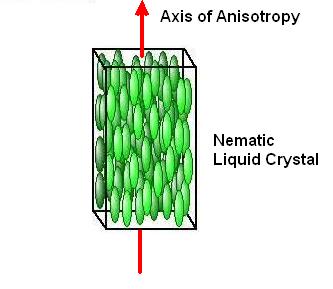
The diagram below shows light entering a birefringent material. Only the E-field is shown, resolved into components along the X- and Y-axis. Upon entering the material light is split into two rays, the ordinary and extraordinary ray, traveling at different velocities. The o-ray and e-ray are plane-polarized along mutually perpendicular directions. The o-ray has polarization perpendicular to the axis of anisotropy and therefore experiences a different index of refraction than the e-ray which has polarization parallel to the axis of anisotropy. The difference in the refraction indices is greatest when the light ray is traveling perpendicular to the axis of anisotropy as portrayed in the diagram. There is an instructive simulation on birefringence available through the website for the PLC project [10] at Case Western Reserve University.
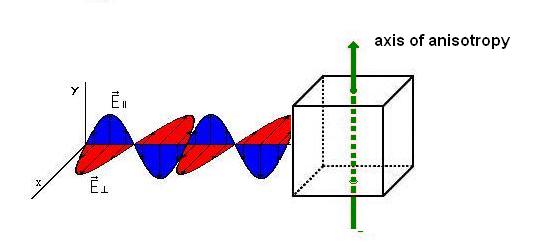
A schematic of a birefringent material showing the axis of anisotropy.
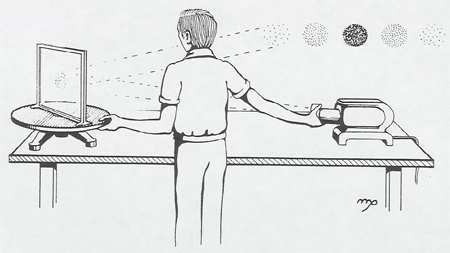
Brewster's angle is nicely demonstrated with the apparatus shown. With the polarizer on the projector horizontal, the reflected beam will be completely extinguished as the glass plate is rotated to Brewster's angle. You can now rotate the polarizer to show polarization of the reflected beam.
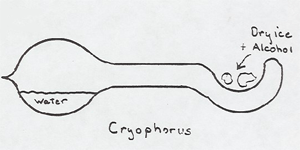
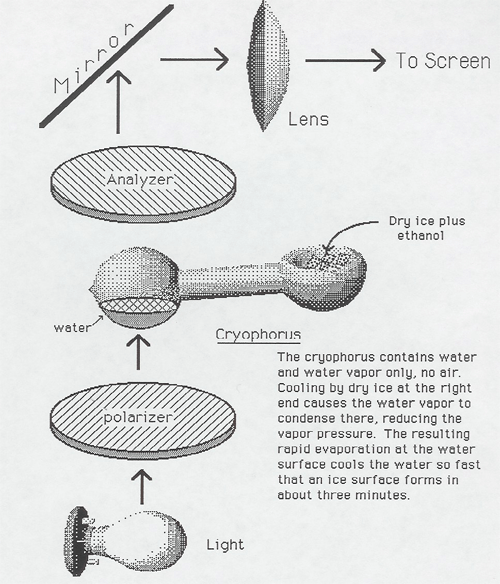
A polarizer and analyzer above and below the bulb end of the cryophorus are crossed to extinguish light transmission and dry ice plus alcohol to increase thermal contact are introduced into the cup end. Rapid evaporation of the water inside the bulb end causes a raft of ice to form. The first time the ice freezes, in about three minutes, many small crystals form at once and jump into view on the overhead screen. The dry ice is now removed, the projector focused carefully, and the cryophorus warmed by hand until the ice melts and the last crystal is just disappearing from the overhead screen. There will still be a few ice crystals left at this point as they melt thinner than the half-wave plate thickness. Dry ice is immediately reintroduced, and in thirty seconds or so beautiful large ice crystals will be seen to grow from the remaining seed crystals, accompanied by Ooh's and Aah's from the class. The demonstration can be repeated several times.
Shown by analyzing light scattered by slide projector. See Sunset Colors from Scattering [11].
Polaroid sheets can be crossed on the overhead projector to show extinction. A third sheet, inserted at 45deg to the other two, will permit 1/8 of the original light to be transmitted. How does inserting a sheet, which can only absorb light, cause more light to be transmitted?
A sodium lamp is arranged to shine on a rear projection screen. An ordinary flame, say of a match or Bunsen burner introduced between the lamp and the screen will not cast a shadow, but if a wire or stick dipped in salt solution is placed in the flame, a dark shadow of the flame appears.
Arc tubes of hydrogen, helium, argon, mercury, and a few others can be viewed three-at-a-time with a large holographic grating. Also available is an incandescent light which can be used to look at a continuous spectrum.
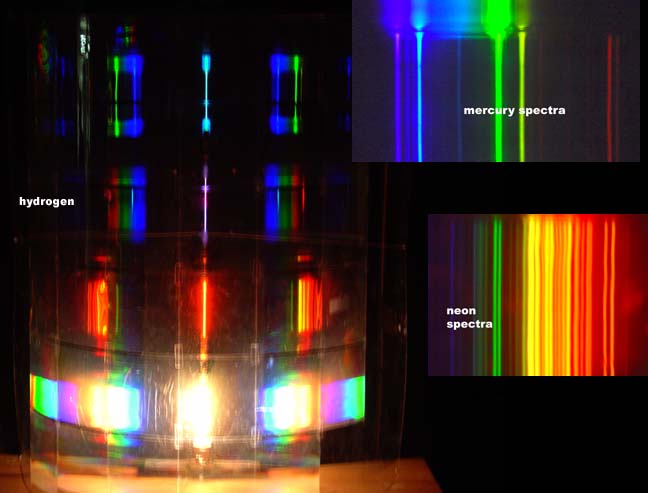
Another option is that students can use individual gratings to see spectral lines of these tubes.
A hollow prism filled with carbon disulphide will disperse white light into its component colors. Other glass and lucite prisms are available, but their dispersion is not as great as CS2.
The action of a diffraction grating itself can be demonstrated by passing a laser beam through the grating and showing the spread out spots on the wall. You can lead into the phenomenon by showing the effect of Single, Double, and Multiple Slits [12] with the Cornell plate. Interesting effects result from crossing two gratings in the laser beam, or by arranging many at all different angles.
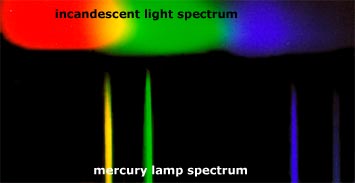
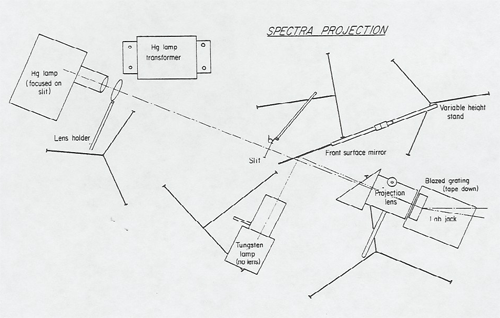
The arrangement below will project the lines of mercury just above their positions in a continuous spectrum of a tungsten filament. By adjusting the height of the 45° mirror you can have the entire length of the mercury lines, mercury lines above continuous spectrum, or just the continuous spectrum. Note that the spectrum of the tungsten filament is deficient in blue as befits a 3000° black body which peaks in the infrared.
Reference instructions for assistant:
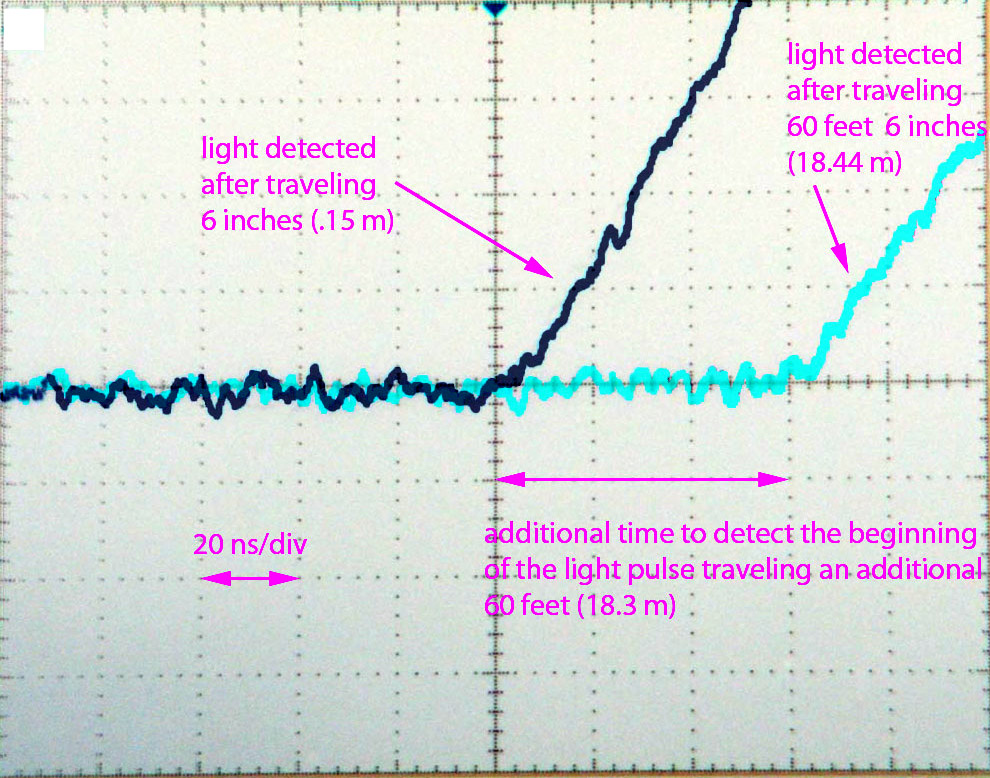
How to measure the speed of light
Winner of 'Great Science Teacher Video Contest' at USA Science and Engineering Festival www.engineering.com

Links:
[1] http://webphysics.davidson.edu/Applets/Applets.html
[2] https://demoweb.physics.ucla.edu/node/371
[3] http://store.nichia.com/index.asp?PageAction=VIEWPROD&ProdID=52
[4] https://demoweb.physics.ucla.edu/node/362
[5] https://demoweb.physics.ucla.edu/node/367
[6] https://demoweb.physics.ucla.edu/node/360
[7] https://demoweb.physics.ucla.edu/node/52
[8] https://phet.colorado.edu/en/simulation/legacy/wave-interference
[9] https://demoweb.physics.ucla.edu/node/281
[10] http://plc.cwru.edu/tutorial/enhanced/lab/lab.htm
[11] https://demoweb.physics.ucla.edu/node/369
[12] https://demoweb.physics.ucla.edu/node/90
[13] https://demoweb.physics.ucla.edu/sites/default/files/demomanual/optics/SpeedofLight/sol_analysis_i.jpg